Friday, May 21, 2010

Could Climate Change Reform Cost Us?


Recently, there has been a lot of effort to get Congress to pass a climate change reform bill. However, due to the already-large amount of things on Congress's agenda, it seems unlikely that it will come to fruition this calendar year. But that doesn't stop people from contemplating the effects that it could have on our society if it is somehow miraculously passed soon. Experts are predicting that the GDP would fall, unemployment would rise, and energy may have a higher cost as it will be taxed more. However, in the long term, this reform would save everybody a lot of money because high efficiency buildings and appliances would be used. Because of that, the effect of greenhouse gases could be reduced and the U.S. would be in charge of that. Sometime in the near future, I can see something like this becoming effective, but in this economy, it does not make sense as people in America don't really need to be paying too much money on something else.

http://www.theatlantic.com/business/archive/2010/05/what-would-climate-change-reform-i-cost-i-us/57019/

Sunday, May 16, 2010

Glacier National Park Melting


The Glacier National Park in Montana just celebrated its 100th anniversary last Tuesday. However, its birthdays are numbered as the glaciers are melting extremely rapidly. Scientists predict that there may be nothing left in ten years. When the park was established in 1911, it had around 150 glaciers. Now, though, it only has 25. Average temperatures in the park have risen 1.8 times faster than the average global temperature, so the change is visible to the naked eye. Receding glaciers leave behind huge moraines, and the increase in temperature is causing more wildfires and lower stream flows, which endangers many fish populations. The animals in the park do not seem to be suffering yet, but spring is arriving three weeks earlier than usual which could disrupt the animals' survival patterns as food grows at different times or becomes scarce. If the glaciers do disappear, it will make international headlines; it's hard for anyone to imagine Montana without its snow capped mountains or glaciers.

http://news.yahoo.com/s/ap_travel/20100511/ap_tr_ge/us_travel_trip_glacier_at100

Thursday, May 13, 2010

The New Smart-Grid

On the Scientific American website, there was an article about the new smart grid, so I thought I would check it out. In this article it talked about how there has been a replacement for the traditional power grid. The traditional grid is known for brownouts and blackouts, but the new grid is leaving its designers with high hopes to reduce the number of problems greatly. The new grid will allow for a "two-way flow of both electricity and data". There is however, one large problem with the new grids. They pose a huge security risk because traditional grids have the problem of cyber-security, but the new grid adds a whole new level of complexity to ensuring the people using the grid safety. The problem with is that a computer hacker who is able to tamper with the smart meters would be able to not only effect a handful of homes, but have the potential to shut down power to 15,000 homes within 24 hours.

http://www.scientificamerican.com/article.cfm?id=securing-the-smart-grid

Sunday, May 9, 2010

Neandertals Bred With Humans


A recent study shows that neandertal's and humans likely interbred. It came as a surpise to researchers, as they had long been looking for evidence of this and had never found it. It is estimated that 1 to 4 percent of the DNA of people from Europe and Asia is neandertal DNA. This has long been studied, as it gives a better picture of how we evolved. Neandertal's lived in that area until they were killed off about 30,000 years ago. The scientists expected to find no related DNA, this result was suprising. Some did predict the result, however. One odd fact is that people living in islands like New Guinea were found to have as much neandertal DNA as people from Europe or Asia, when neandertal's never lived there. At least one leading scientist now believes that we cannot classify neandertal's as different from us. He believes that we are essentially the same race. http://www.sciencenews.org/view/generic/id/58936/title/Neandertal_genome_yields_evidence_of_interbreeding_with_humans

Louisiana Oil Spill Reaches Wildlife Refuge


This article is about two parts of the oil spill. One is the oil spill reaching a Wildlife Refuge and the other is about efforts to contain the oil spill and clean up the oil.

The uninhabited Chandeleur Islands, off the coast of Louisiana, are part of the Breton National Wildlife Refuge, which is the second oldest Wildlife Refuge in America. Pelicans and other birds that are covered in oil have been found on these islands, and a federal Maritime agency said there was "oiling all over"the islands. There is also an oily substance that is washing up on New Harbor Island, which serves as a roosting place for thousands of frigate birds. Everyone is worried about the impact that this oil spill will have on the fishing economy since the area is a vital spawning ground for fish, shrimp and crabs. One fisherman is quoted saying, "It's all over the place... that's our whole fishing ground. That's our livelihood". The effects of this oil spill on the environment are, and will be, awful - especially if the oil continues to affect Wildlife Refuges like the Chandeleur Islands.

Ever since the explosion, 18 days ago, oil has been leaking non-stop into the Gulf of Mexico. People have been criticizing BP on its slow response time, and BP has argued back that they have sent out 100 boats to skim the oil off the water (including 20 of the worlds largest skimming vessels), thousands of feet of boom are trying to contain the oil and planes are flying over deploying dispersants. Apparently the smallest of the three leaks has been sealed and crews are burning off some of the oil in the parts where there is a heavy concentration. BP is attempting to contain the leaking oil by putting a giant iron funnel over the leak. It'll try to capture about 85% of the leaking oil and funnel it up to a barge. This has been used in shallower waters but they're hoping it'll work for this leak too. A few problems may occur while using this funnel - the device may damage the well and make the leak worse, ice may clog the drill pipe, and explosions may occur at the surface while trying to separate the mix of oil, gas and water.

Hopefully the funnel will work because the oil spill is bad enough without the continuous leaking of even more oil into the gulf. This article is pretty optimistic that the funnel will work but didn't say much about how helpful the methods of cleaning up the oil will be and how bad the threat against the Wildlife Refuges is. I hope they'll be able to clear up as much oil as possible and that the ecosystems won't be too badly damaged, but I guess we can't tell how bad it will be until the oil is cleared up.

Link to article from the BBC

Wednesday, May 5, 2010

New study shows that future temperatures could be lethal

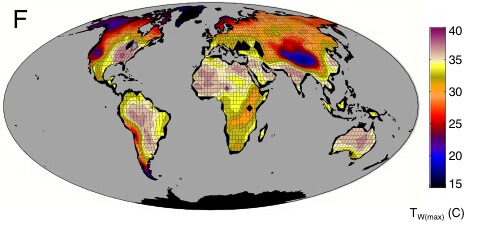
For the first time scientists have calculated the highest wet bulb temperature that humans can tolerate. We calculated wet bulb temperatures in a unit a couple months ago (it is equal to what is felt when wet skin is exposed to moving air and it includes the temperature and atmospheric huidity). Researchers discovered that if a human or animal is exposed to wet bulb temperatures above 95 degrees for at least six hours they will experience potentially lethal levels of heat stress. The Intergovernmental Panel on Climate Change estimates that if the world continues warming at the same rate it is now, by 2100 average global temperatures will have risen by seven degrees Farenheit. The study has found that a warming of twelve degrees Farenheit would cause parts of the world to surpass the wet-bulb temperature limit, and that a warming of 21-degrees would place fifty percent of the globe in an unlivable environment. Researchers say that if nothing is done to slow global warming we may very well reach these temperatures, pretty scary!

The map of the world shows the wet-bulb temperatures that would occur around the world with a global-mean temperature increase of 21 degrees farenheit. The white coloring portrays areas that humans would experienced potentially lethal heat stress.

Monday, May 3, 2010

Mammoths are cool!


I chose this story because I feel like recently the news has been overcome by volcanoes, floods, oil spills, and earthquakes. No one really ever hears about really cool mammoths with anti-freeze blood anymore.

Apparently wooly mammoths used more than their thick fur to stay warm in the ice age and it's cold arctic winters. Recently scientists have discovered that mammoths had a genetic adaptation in their blood allowing their haemoglobin to release oxygen into their bodies at extremely low temperatures. In this way their blood was similar to anti-freeze! This adaptation probably helped them keep their oxygen moving which kept helped them concentrate their heat internally and stop heat loss. They discovered this by extracting a DNA sample from the remains of a 43,000 year old wooly mammoth. The converted the DNA into RNA and then put it in e. coli bacteria which helped produce the mammoth protein of the 43,000 year old specimen. If they didn't have this adaptation they would have to eat a lot more, much more often so that they could get their energy from food. This would have posed a large problem in the winter when there wasn't a large food supply. This adaptation for mammoths was dealt to deal with the cold just as their elephant relatives adapted to the African heat by having large ears and no thick coat of fur.

-Katie Powell


http://news.bbc.co.uk/2/hi/science/nature/8657464.stm

Sunday, April 25, 2010

"Colorado River water policy faces an age of limits"


Scientists are expecting a significant reduction in flow for the Colorado River. The fundamental problem is with the Colorado River Basin. Six species are already threatened or endangered due to invasive quagga mussels. The Colorado has severe water quality issues leading to a shortage of surface water. Hence communities are starting to mine groundwater. Agriculture is expected to take an immense hit from this. I found this article dismal yet extremely informative.

http://www.sltrib.com/opinion/ci_14921852

Friday, April 23, 2010

unit review


5 major sources of oil spills:
-natural seeps
-extraction
-transportation/tankers
-pipelines
-runoff

4 short term effects of oil spills:
-reduction of light transmissions
-reduction in dissolved oxygen
-damage to marine birds
-toxic effects to marine environments

2 long term effects:
-block taste receptors causing fish to eat harmful things
- it can concentrate poisons

Methods of cleanup:
-booms or barriers--used to contain the oil spill
-skimmers-- skim oil off surface and into boats
-sorbents--used to soak up and contain spill
-chemical dispersants--used to degrade the oil
-flames-- used to burn oil

Dow Life Earth Run for Water


On April 18th, the DOW Earth Run for Water is a charity run that had tens of thousands of participants around the world. The run is an event that celebrities and civilians alike could participate in. The purpose of the run was to raise awareness to the fact that we need to have cleaner water. Tonight on Bravo there is a special show to highlight the current water crisis through out the world. This year the run went very well, so they hope to do it next year too.

New species of killer whales


A new study has found strong genetic evidence which points to the presence of several different species of killer whales in the world's oceans. The research has appeared in the journal Genome Research.Scientists have suspected for some time that there was more than one species of killer whales because of differences in behaviour, feeding preferences and subtle physical features. But until now DNA analysis has been inconclusive because of the inability to map the entire genetic picture, or genome, of the whales' mitochondria inherited from the mother. As a result of the study, two types of killer whales in the Antarctic that eat fish and seals, respectively, are suggested as separate species, along with mammal-eating "transient" killer whales in the North Pacific.

http://www.dnaindia.com/scitech/report_several-new-species-of-killer-whales-likely-to-be-found-in-oceans_1374822

Evolution of Earth Day


Earth Day began 40 years ago as a day to recognize the environment. 40 years ago, there was no talk of global warming or the green movement. Rather, the original purpose was to emphasize ecology and the power of cleaning up litter and pollution. Before earth day, Americans were rather uninformed about the environment other than a few radical environmentalists. Today, the green movement is sweeping the nation. Today, major environmental organizations like the EPA and WWF hold events to raise awareness. Also, major companies like UPS, P&G and Wells Fargo sponsor Earth Day events. Over the past 40 years, Earth Day has evolved from a hippie event to a major environmental awareness day.

http://www.google.com/hostednews/ap/article/ALeqM5hRQcGJRPZAitgVuKGUNrYVYm0hAgD9F8CFL00

More Oil Spills

A few days ago a large oil rig in the Gulf of Mexico exploded. The major concern for everyone is making sure all the workers are safe. The majority of the workers were able to evacuate unharmed, and with only 11 people missing. It is believed that those 11 did not make it out in time but searches are still going on. Second to the human issue is the amount of crude oil released. At this time officials are unsure if the spill will be detrimental or if they can clean in up in time. Unfortunately it is still unknown as to caused the explosion, but officials speculate that it was because of worker negligence.

Feel free to head over to http://www.cnn.com/2010/US/04/22/oil.rig.explosion/index.html?hpt=T1 for a video of the explosion.

dEaD zOnEs

There is a problem that commonly plagues bodies of water called "Dead Zones." These are zones that have no life in them and that is why they are called dead zones. Dead zones can occur due to a slew of reasons. One being eutrophication. This is when there is not enough dissolved oxygen in the water for fish to live. This depletion of oxygen occurs because there are too many nutrients in the water and this causes bacteria to grow out of control and then the bacteria that eats this eats up all the oxygen as well causing fish to die. This is why they are called dead zones is because all the fish die. There are other reasons for these zones of no life. Another being algal blooms. These can be poisonous blooms of an algae that usually occurs because there is a change in temperature or too many nutrients. This can poison the fish and cause them to die. It can also poison humans so it is important to not eat seafood that comes from a poisonous algal bloom.

EARTH DAY


I read an article in the New York Times talking about how companies are marketing a lot of products off of Earth Day. For example, the company Bahama Umbrellas is marketing an umbrella that has as drain so that you can store the water and recycle it. When Earth Day made its first appearance in 1970 most people were pretty against it, but now a lot of companies are making it into a marketing idea. This goes to show how people are actually starting to accept global warming and the fact that we need to protect our earth.

Oil Spills

So, since we were recently talking about oil spills and oil spills hit close to home, I thought I would do a unit review on them.

Oil pollution sources: oil tankers, run-off from boats in the marinas, waste & sewage, off-shore drilling accidents, natural sepage, road run-off from cars and pipe line leaks.

Short term effects: the reduction of light transmition results in the reduction of dissolved H2O because of photosynthesis, oil getting on the aquatic life can drown them or make them handicap, and the toxic effects can destruct a huge range of species including fish, shellfish, worms, crabs, microcrustaceans and other invertebrates.

Long term effects:the oil compounds interfere with the chemical messangers of the marine life, and that can block receptors including taste and smell. The oil can also mimic the receptors, which causes disasterous effects. Oil can also sereve as a concentrated medium in fertalizers which makes it way into the marine food chain and then eventually into humans.

Clean-up methods: there are many cleanup methods that include using booms or barriers to contain the spill, skimmers to remove the oil from the surface, absorbents to absorb the oil that has gotten deeper than the surface,.chemical dispertants that degrade the oil, and flames which burn the oil spill. Personally, I feel like bioremediation is the best method to remove oil, and this involves using naturally occuring microorganisms that have been genetically engineered so they can degrade the petroleum.

hope this helps!

Oil Spills

Oil Spills are caused by
Ships with oil breaking
Runoff from boats
Waste that is put in the ocean
Off Shore drilling
Natural seepage
and road runoff

When the oil is spilled it goes in to oceans lakes and rivers

The effects of these spills cause reduction of light transmission, reduction of dissolved oxygen, the oil sticks to marine mammals and birds, and it destroys the marine environment.

There are 6 ways of cleaning up the oil: Mechanicals-booms, Skimmers, absorbents, chemicals dispersants and detergents, burning the oil and bioremediation.

Airplanes in Ash Clouds

When an airplane passes through an ash cloud it is disastorous for the passengers, pilots, and crew members. The ash can coat the entire windsheild, making it impossible for the pilots to see, but if the ash is sucked into the engines, it can cause the engines to stall out. This will essentially cause the plane to free fall. This has happened twice before, and the pilots were able to restart some of the engines and do an emergency landing. Here is a video clip that explains what is happening in England, and what exactly happens when a plane engine encounters volcanic ash.
http://link.brightcove.com/services/player/bcpid69900095001?bctid=78324298001

Thursday, April 22, 2010

Oil Rig Explosion


Just today in class we briefly looked at the oil rig explosion in the gulf of mexico. More news in beginning to come in about that explosion and its effects on the environment. In an article in the New York Times they said that it is getting more and more complicating to contain the damage from the burning rig that left a one-by-five-mile sheen of what the authorities said was “crude oil mix.” They are saying that it has great potential to have to be a major spill. There were 115 survivors from the explosion and they are saying that there is a very small chance that the lost 11 workers are alive. The owners of the rig said they are not sure if the rig is still emitting gas or oil underwater because they said that the workers “were not able to stem the flow of hydrocarbons” before the rig sank. There is also potentially 700000 gallons of diesel fuel that was on the rig could be part of the leak. BP now released 30 skimming vessels to try to contain the spill. This whole situation has brought up old fears about the safety of offshore oil rigs and their relationship to the environment

http://www.nytimes.com/2010/04/23/us/23rig.html?src=mv

Water Testing

For the test we don't have to know HOW we tested for the chemicals in water, we just need to know WHAT we tested for. So here is a list for all of those chemicals/tests.
  • Water temperature
  • Ammonia Nitrogen
  • pH
  • Chlorine
  • Chromium
  • Copper
  • Iron
  • Nitrate Nitrogen
  • Phosphorus
  • Silica (sand)
  • Sulfide